
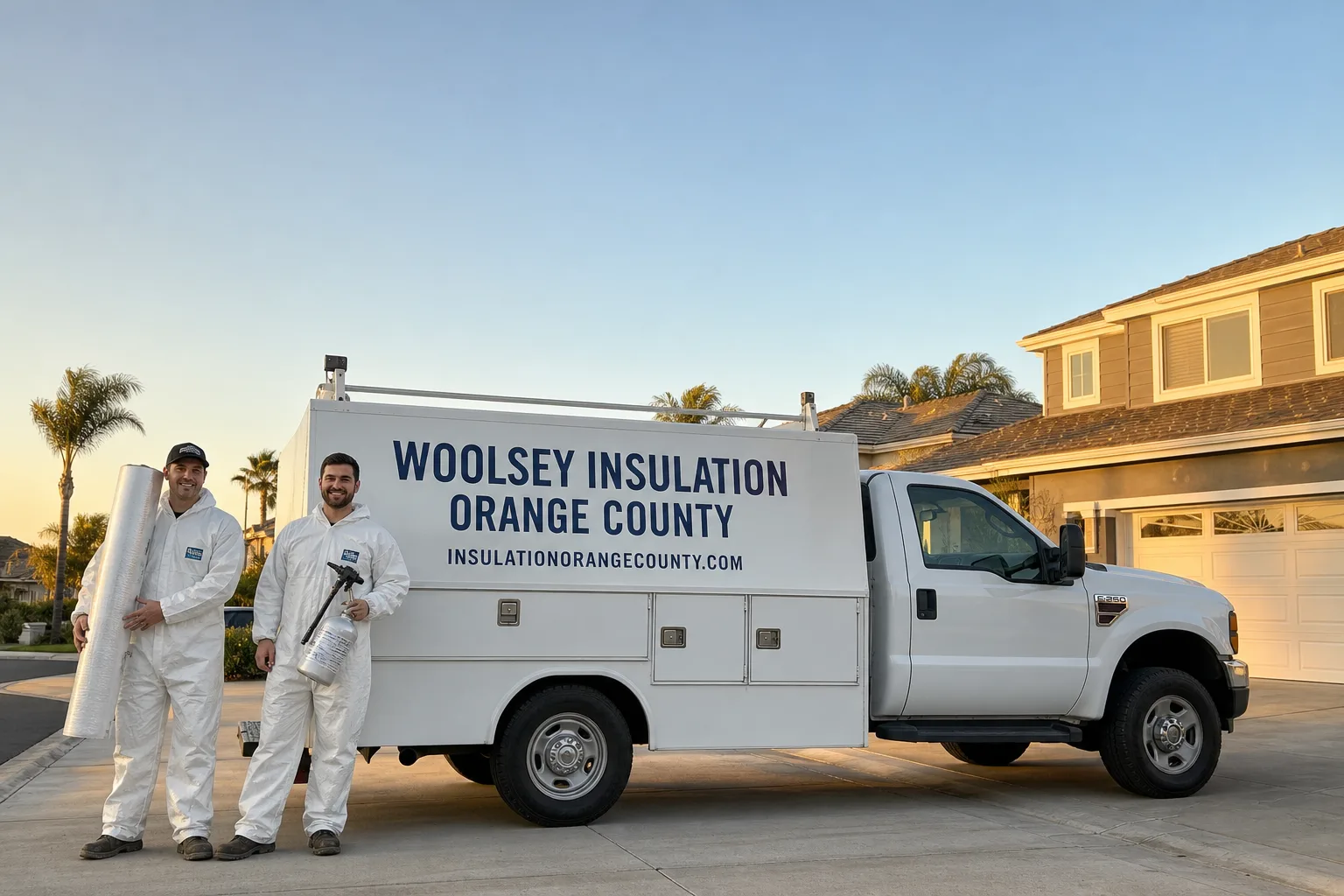
How Much Does Radiant Barrier Installation Cost in Orange County?
Radiant barrier installation in Orange County typically costs between $1,200 and $3,400 for a standard single-family home, with most homeowners paying around $1,800 to $2,600 for foil radiant barrier stapled to the underside of roof rafters in an average 1,500 to 2,200 square foot attic. That works out to roughly $0.80 to $1.60 per square foot of attic floor area, or $1.50 to $3.00 per square foot of barrier material installed. The final number depends on your attic’s accessibility, whether you want a single-sided or double-sided foil product, and whether the job requires any prep work like clearing stored items or repairing damaged decking.
We give you the exact written number before any work starts, so you’ll never see a price shift at the door. If you want a real quote for your attic, call (831) 480-6682 and we’ll schedule a free estimate.
Key Takeaways
- Most Orange County radiant barrier jobs land between $1,800 and $2,600 for an average home.
- You’ll pay roughly $0.80 to $1.60 per square foot of attic floor space.
- Foil type (single-sided vs. double-sided), attic height, and accessibility are the biggest price drivers.
- Radiant barriers work best paired with existing attic insulation; they’re not a replacement for it.
- Expect the job to take 3 to 6 hours for most homes; larger or cluttered attics take a full day.
- Free estimates are standard practice; never pay for a quote.
Radiant Barrier Installation Cost Breakdown (2026)
Here’s what you should expect to pay in the Orange County market this year. These numbers reflect what we’ve seen across Anaheim, Santa Ana, Irvine, Huntington Beach, Garden Grove, Orange, Fullerton, Costa Mesa, and the surrounding communities.
| Line Item | Typical Range | Notes |
|---|---|---|
| Single-sided foil radiant barrier (material only) | $0.15 – $0.40 per sq. ft. | Foil on one side, kraft paper or mesh backing on the other. Fine for most attics. |
| Double-sided foil radiant barrier (material only) | $0.30 – $0.60 per sq. ft. | Foil on both sides. Slightly higher reflectivity, better durability in high-humidity attics. |
| Labor (stapling to rafters, typical attic) | $0.65 – $1.10 per sq. ft. | Includes setup, attic access, seam overlap, and clean-up. |
| Total installed cost, 1,500 sq. ft. attic | $1,200 – $2,200 | Single-sided product, standard rafter spacing. |
| Total installed cost, 2,200 sq. ft. attic | $1,800 – $3,400 | Double-sided product, complex roofline, or attic prep work included. |
| Attic prep / debris removal | $150 – $500 | Clearing stored boxes, old insulation debris, or pest droppings before work begins. |
| Radiant barrier + attic insulation combo | $2,800 – $6,500 | Adding blown-in fiberglass or cellulose while the crew is up there. |
If your attic has a simple gable roof with standard joist spacing and easy access, you’ll sit at the low end of these ranges. A hip roof in a 1970s Anaheim Hills home with a cramped 3-foot ceiling and years of stored holiday decorations? Expect to pay more. We’re honest about that math up front.
What Affects Radiant Barrier Installation Pricing in Orange County
No two attics are the same, even in the same neighborhood. Here’s what actually moves the number on your quote:
- Attic height and access. Older Orange County homes, especially 1950s and 1960s tract housing in Garden Grove, Westminster, and Buena Park, often have attics with 3 to 4 feet of headroom. That means technicians work hunched or on their knees, which slows the job down. Newer builds in Irvine and Aliso Viejo tend to have more clearance, and the labor cost reflects that.
- Foil type and thickness. Single-sided radiant barrier is the workhorse product for most California attics. Double-sided costs more but holds up better in coastal humidity zones like Huntington Beach, Newport Beach, and Laguna Niguel, where morning marine layer seeps into vented attics and can degrade kraft-paper backing over time.
- Roof geometry. A simple gable roof takes far less time than a complex hip or gambrel roof with valleys, dormers, and short rafter bays. More cuts, more staples, more labor hours. Anaheim Hills and Orange Park Acres have a lot of custom-build rooflines that run higher on labor.
- Attic prep and cleanup. If there are boxes of old tax returns stacked across the joists, old batt insulation falling apart, or evidence of rodent activity, someone has to deal with that first. We’ll quote it as a separate line item so you know exactly what you’re paying for.
- Whether you’re pairing it with insulation. Radiant barrier reflects radiant heat, but it doesn’t slow conductive or convective heat transfer. That’s what insulation does. In Orange County, where summer attic temperatures regularly hit 140°F in August, a barrier plus proper attic insulation together deliver the biggest comfort payoff. Combining both in one visit saves on trip fees and setup costs.
- Time of year. Summer is peak season for radiant barrier work in Orange County for obvious reasons. Booking in spring or fall sometimes gives you more scheduling flexibility, though our pricing stays consistent year-round. We don’t upcharge for the heat, and we don’t discount our way into a bad installation.
Is Radiant Barrier Worth the Cost in Orange County?
Short answer: for most homes here, yes, especially if your air conditioner runs hard from July through October.
Radiant barrier is a reflective foil that bounces radiant heat back toward the roof deck instead of letting it radiate down into your attic and then into your living space. In the Orange County climate, where we get 280+ sunny days a year and summer rooftop temperatures can exceed 160°F, a properly installed barrier can reduce attic temperatures by 20°F to 30°F on a hot afternoon, according to building science research from the Florida Solar Energy Center and Oak Ridge National Laboratory. That means your air handler and ductwork work less hard, which translates into lower cooling costs and longer HVAC equipment life.
What radiant barrier doesn’t do is replace insulation. Think of it this way: insulation slows heat transfer through the attic floor, while radiant barrier stops heat from getting into the attic in the first place. They’re different tools for the same fight. Most Orange County homes need both to truly manage a 140°F attic in August.
The payback math depends on your home’s exposure, your AC usage, and your utility rate. Homes with a large south- or west-facing roofline in Fullerton, Yorba Linda, or Mission Viejo get the fastest return because their roofs take direct afternoon sun. Homes with heavy tree cover in places like Tustin or Villa Park take longer to recoup the cost through energy savings alone, but the comfort improvement is immediate.
Radiant Barrier vs. Just Adding More Insulation
We get this question weekly: should I spend my budget on radiant barrier or on topping up my attic insulation? Here’s the honest answer.
If your attic has less than R-30 of insulation currently, that’s your first priority. Building code in California calls for R-30 to R-38 in most of Orange County, and most homes built before 2000 sit well below that. Insulation delivers year-round benefits, both keeping heat out in summer and trapping it in during our cooler winter nights.
Radiant barrier is the layer that adds the biggest incremental summer comfort gain once insulation is adequate. In coastal communities like San Clemente and Dana Point, where winter heating demand is minimal and summer cooling demand isn’t as extreme as inland, radiant barrier alone often provides less payoff than in Yorba Linda or Rancho Santa Margarita. Inland gets hot. Coastal gets mild. Where your home sits on that spectrum matters.
The ideal scenario for an Orange County attic: R-38 blown-in fiberglass or cellulose on the attic floor, plus a single-sided foil radiant barrier on the rafters. That combination handles all three heat transfer pathways and is what we’d recommend for anyone planning to stay in their home for more than five years. If you’d like a written breakdown of what that combo would cost for your home, call (831) 480-6682 and we’ll put real numbers in front of you.
How the Installation Process Works (And Why It Matters for Your Price)
Radiant barrier installation is not rocket science, but doing it wrong means zero benefit and a bad-looking attic. Here’s how the job runs, Kingswell style: say the price, show up in the window, leave it cleaner than you found it, put the guarantee in writing, come back if it fails.
The estimate
A technician comes out, looks at your attic access, measures the square footage, checks the rafter spacing, and assesses any prep work needed. You get a written price before any work starts, broken down by material and labor. No verbal numbers, no “we’ll see how it goes.” A number on paper, good for acceptance.
The installation
Crews arrive in the promised window, in uniform, background-checked, and they lay drop cloths below the attic access and around the work path. The barrier is stapled to the underside of the roof rafters, foil side facing down toward the attic floor, with a 1 to 2 inch gap between each run to allow for airflow and moisture escape. That air gap is essential – foil pressed directly against a surface loses most of its reflectivity. If your attic has existing vents, soffit channels, or recessed light housings, those get careful cuts to preserve airflow and avoid covering anything that shouldn’t be covered.
The check and the paperwork
When the job is done, the crew walks you through what was installed, shows you photos of the finished attic, and leaves behind a written guarantee. If anything isn’t right within 365 days, Woolsey comes back and fixes it at no charge. That’s the 365-Day Done Right Promise, and it’s on every radiant barrier installation we do.
How to Save on Radiant Barrier Installation
You don’t have to overpay for this job, and you don’t have to cut corners either. Here’s how to get the best value in Orange County:
- Bundle with attic insulation. If your attic insulation is thin or old, doing radiant barrier and insulation in the same visit saves on labor overlap and trip charges. The combined job is often 15 to 20 percent cheaper than doing them separately six months apart.
- Handle attic cleanup yourself. If your attic has stored items, clearing them out before the crew arrives saves the $150 to $500 prep line item. Wear a mask, gloves, and watch for nails while you’re up there.
- Get multiple written quotes, but read them carefully. A cheap quote that leaves the material vague or the guarantee undefined isn’t a deal. Make sure the quote specifies the product (brand and foil type), the square footage, and the guarantee terms.
- Ask about the foil’s emissivity rating. A good radiant barrier should have an emissivity of 0.05 or lower (meaning it reflects 95% or more of radiant heat). Cheap products with emissivity of 0.15 or higher don’t perform meaningfully better than plain kraft paper. The barrier is only as good as its reflective surface.
- Check whether you qualify for utility rebates. Some Orange County utilities and local governments have offered rebate programs for reflective insulation and other energy-efficiency upgrades. These change often, so ask your energy provider directly.
- Get a free estimate, not a phone quote. Any contractor who quotes you over the phone without looking at your attic is guessing. A free in-home estimate is the only way to get a real number. Ours are free, and the written price you receive is the price you’ll pay. To schedule, call (831) 480-6682.
Radiant Barrier Material Options: What You Should Know
Not all foil is created equal. Here’s what you’ll encounter in the Orange County market:
Single-sided radiant barrier. One side is reinforced foil, the other side is bonded to kraft paper or a synthetic mesh. This is the standard residential product. It’s easy to work with, staples cleanly to rafters, and costs less per square foot. For most homes with adequate roof ventilation, single-sided is entirely sufficient.
Double-sided radiant barrier. Foil on both sides with a reinforcing scrim between them. It reflects from both directions, though in an attic application only one side is doing the real work. The advantage is tear resistance and longevity in damp conditions. If your attic in Costa Mesa or Seal Beach gets regular morning marine layer and your vents pull that moisture in, double-sided holds up better over time.
Perforated vs. solid foil. Perforated barriers have tiny holes that allow moisture vapor to pass through, which prevents condensation buildup on the cold surface of the foil during winter. In Orange County’s mild climate, condensation is a smaller risk than in the Southeast, but perforated product is still the safer choice if your attic has any history of moisture issues or if you’re applying barrier over existing insulation.
We work with eight leading insulation brands including Owens Corning, Johns Manville, Knauf, Rockwool, CertainTeed, Icynene, Demilec, and GreenFiber, so the material recommendation fits your attic’s ventilation profile and your budget, not whatever happens to be on the truck that day.
Will Radiant Barrier Void My Roof Warranty?
This is a legitimate concern and it’s worth addressing head-on. In most cases, installing radiant barrier on the underside of your rafters does not void a roofing manufacturer’s warranty, because the barrier is attached to the interior side of the roof structure, not between the decking and the shingles. That said, if your roof is newer and the warranty matters to you, read the warranty language or call the manufacturer. Some of them have specific verbiage about attic ventilation changes and may require that you maintain existing ridge and soffit vent airflow. A properly installed barrier does that. A sloppy one stuffed into the soffit channels could cause problems.
This is exactly why you want a crew that understands airflow dynamics and doesn’t just staple foil across every surface they find. Our technicians cut around vent openings, leave the soffit channels open, and preserve the air gap that makes both the barrier and your roof ventilation work correctly.
How Much Does Radiant Barrier Installation Cost in Orange County?
We already covered the headline number above, and here’s the radiant barrier installation in Orange County page for the full service breakdown. If you’re browsing from a specific city, here’s a quick local snapshot:
- Anaheim / Fullerton / Buena Park: Older flat-lot tract homes with simple gable roofs; expect $1,500 to $2,400 for a standard attic.
- Irvine / Tustin / Lake Forest: Newer construction with higher attic clearance and simpler access; expect $1,300 to $2,200, though larger homes push the upper bound.
- Huntington Beach / Costa Mesa / Newport Beach: Coastal humidity means we lean toward double-sided product; expect $1,800 to $3,000 depending on attic size and moisture resistance needs.
- Yorba Linda / Anaheim Hills / Orange Park Acres: Larger custom homes with complex rooflines and bigger attics; expect $2,200 to $3,400 or more.
- Mission Viejo / Rancho Santa Margarita: Saddleback Valley homes get intense afternoon sun; the barrier pays for itself fastest here. Expect $1,600 to $2,800.
These are ranges, not promises. Your house is different. The only way to know is to measure the attic and write a real quote, which we do for free. Call (831) 480-6682 and we’ll get you a written price before any work starts.
FAQs – Radiant Barrier Installation Cost
How much does radiant barrier cost per square foot in Orange County?
Installed radiant barrier runs $0.80 to $1.60 per square foot of attic floor area, including material and labor. A 1,500 square foot attic at that rate costs $1,200 to $2,400. Call (831) 480-6682 for a written quote on your specific attic – estimates are free.
Is radiant barrier worth the money in Orange County?
For most Orange County homes with a south- or west-facing roof and summer AC bills over $200 a month, yes. A properly installed barrier cuts attic temperatures by 20°F to 30°F on hot days, which reduces the cooling load on your HVAC system. The payback period typically runs 3 to 7 years depending on your home’s exposure and insulation levels. Homes in Fullerton, Yorba Linda, and Mission Viejo see the fastest returns.
Can you install radiant barrier in one day?
Yes. A standard 1,500 to 2,000 square foot attic takes 3 to 6 hours, which means we’re in and out the same day. Larger attics with complex rooflines, prep work, or a bundled insulation job can run a full day. We’ll tell you the timeline when we write the estimate.
What’s the difference between radiant barrier and attic insulation?
Radiant barrier reflects radiant heat back toward the roof deck, keeping it from entering the attic in the first place. Attic insulation slows the conductive heat transfer between the attic and your living space. They serve different purposes, and ideally you want both: R-38 insulation on the attic floor plus reflective barrier on the rafters. Costs for the combined job in Orange County run $2,800 to $6,500 depending on attic size.
Does radiant barrier cause roof shingle damage or void warranties?
When installed correctly with the proper air gap and vent clearances, no. The concern would be trapping heat against the underside of the roof deck, but radiant barrier installed with the recommended 1 to 2 inch gap actually reduces the heat absorbed by the roof assembly compared to a bare attic. Proper installation preserves soffit and ridge vent airflow. We cut around all vent openings and never block airflow paths. Every job includes our 365-Day Done Right Promise – if anything isn’t right within a year, we come back and fix it at no charge.
Your Next Step: A Real Number, In Writing
You can read pricing guides all day, but the only number that matters is the one for your attic. We measure it, we assess it, and we hand you a written price before any work begins, every single time. No door-step surprises, no shifting estimates. That’s the Kingswell Way, and it’s been that way since 2002.
Woolsey Attic Insulation is led by Glenn Hartley, and we’ve spent more than two decades in Orange County attics. We know which foil products last in a damp Seal Beach attic and which ones waste your money in a hot Yorba Linda one. We answer the phone with a live person 24/7 – no voicemail maze – and every crew member who steps onto your property is background-checked and in uniform.
If you want a real number for radiant barrier installation in your Orange County home, call (831) 480-6682 today. We’ll schedule a free estimate at a time that works for you, show up when we say we will, and put the price in writing before anything else happens.
Back to home for more on how we run every job.
Written by Glenn Hartley, Owner at Woolsey Insulation Orange County, serving Orange County since 2002. Pricing reflects the Orange County market as of 2026. Woolsey Insulation Orange County offers free estimates – call (831) 480-6682.
What Our Customers Say
"Our old insulation was flattened and basically useless. They removed it, cleaned up, and blew in new. Furnace isn't running constantly anymore and the first bill already showed it."
- Carl Yeung"Spray foam in the crawlspace and new attic insulation. They wrote up the whole price and the two jobs came in exactly as quoted. Floors upstairs aren't freezing in the morning anymore."
- Nathan Pruitt"Drafty old house that never felt comfortable. After the attic and some air sealing it's a different place. On time, clean, and the quote didn't change. Wish I'd done it years ago."
- Dmitri Kozlov